

2026 Outlook: The 3 Automation Trends Shaping Australian Fitness
The “24/7” model changed the Australian fitness landscape forever. It democratised gym access, expanded the addressable market, and proved that members valued convenience over constant staff presence. But in 2026, simply being “open” isn’t enough.
The new battleground is efficiency.
Rising wages, increased energy costs, and operational overheads mean that Australian gym owners are under relentless pressure to do more with less. The answer isn’t cutting service or reducing quality. It’s automating the repetitive, time-consuming tasks that drain your team’s energy and fragment your cash flow.
Here are the three automation trends we see defining the year ahead for fitness businesses across Australia.
Trend 1: The “zero-touch” joiner journey
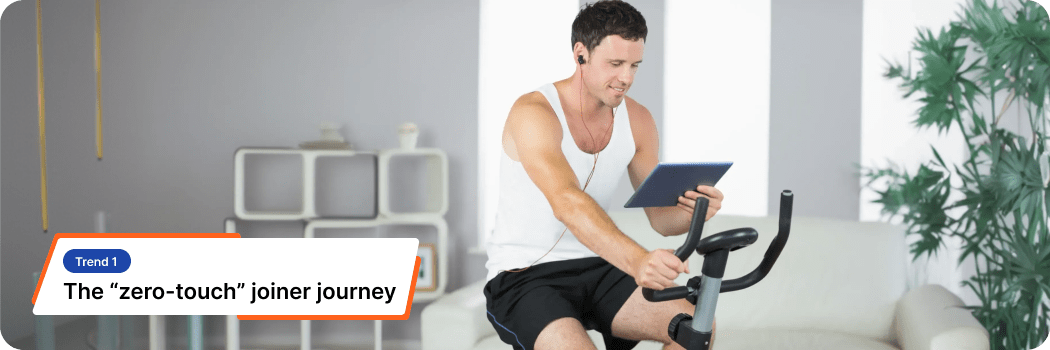
In 2026, a prospect should be able to join your gym at 11:00 PM on a Sunday and be working out by 11:05 PM without speaking to a human.
This isn’t about replacing personal service. It’s about removing friction for members who want to join immediately, at their convenience, rather than waiting until your reception desk opens on Monday morning.
Why this matters now
Consumer expectations have shifted. Online shopping, banking, and entertainment all operate 24/7 with instant fulfilment. Your gym should too.
If a prospect lands on your website at midnight, reads your pricing, and decides they want to join, any barrier between that moment and membership activation is a conversion risk. They might change their mind overnight, compare you to competitors who offer instant sign-up, or forget they were interested by the time your office opens.
The “impulse buy” window in fitness is narrow. If you make people wait, you lose them.
The technology that enables zero-touch joining
Modern online joining portals integrate directly with your gym management software, access control, and billing systems. Here’s how the process works. First, the prospect visits your website. They browse membership options, read terms, and select a plan. Then they complete a digital sign-up form with their details, upload a photo if required, and sign waivers electronically. Next comes automated payment setup. They enter their bank details, and the system sets up direct debit immediately. Their membership activates instantly, and they receive a QR code or app-based access credential via email or SMS. Finally, a welcome sequence begins with automated emails that introduce them to your gym, explain how to book classes, and encourage them to complete their first workout. The entire process takes less than 5 minutes and requires no manual input from your team.The competitive advantage
Gyms that offer zero-touch joining capture members that competitors with manual sign-up processes lose. It’s particularly powerful for late-night browsers (people researching gyms after work who want to make a decision immediately), impulsive buyers (prospects who are motivated right now but might lose enthusiasm if they have to wait), and busy professionals (members who don’t want to schedule a tour or wait for a callback). If your competitor requires a phone call or an in-person visit to join, and you don’t, you’ve just gained a significant edge.What this means for your team
Zero-touch joining doesn’t eliminate the need for staff. It frees them up to focus on high-value activities like personal training consultations, member check-ins and engagement, induction and safety training, and community-building events. Your team stops being gatekeepers and starts being coaches, which improves both member satisfaction and staff morale.Trend 2: Retention radar (AI-driven intervention)
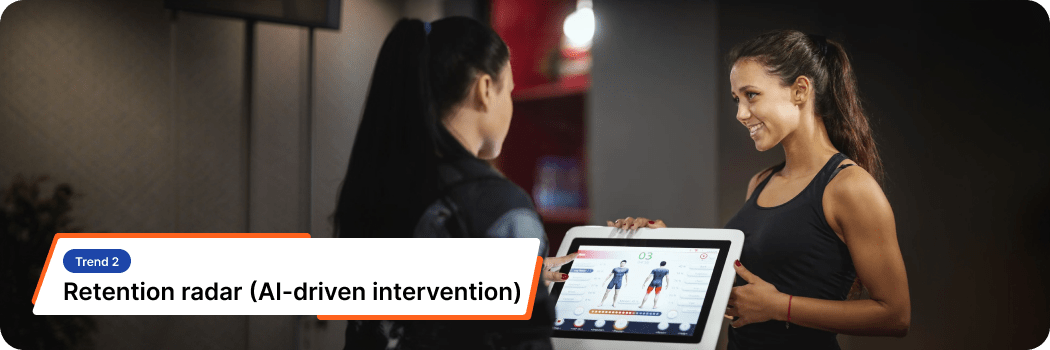 We used to wait for a cancellation form to know a member was unhappy. By then, it was too late. In 2026, automation tells us before they leave, giving us a chance to intervene early and save the membership.
The silent leaver problem
Most gym cancellations don’t come with drama. Members don’t complain. They don’t email. They just stop showing up, and then they quietly cancel. By the time you notice, the relationship is already over. This “silent leaver” phenomenon is one of the biggest threats to gym profitability. According to industry research, gyms lose up to 30% of their members annually, and the majority of those cancellations are preventable if caught early. The challenge is visibility. If you have 1,000 active members, manually tracking who’s attending and who’s disappeared is impossible. That’s where automation comes in.How retention radar works
Modern gym management systems automatically identify at-risk members using attendance data. Here’s a common workflow. Trigger 1: 14-day absence If a member who normally trains 3 to 4 times per week hasn’t swiped in for 14 days, the system sends an automated “We miss you” SMS or email. The message is friendly, non-salesy, and includes a simple call-to-action like: “Hey Sarah, we noticed you haven’t been in lately. Everything okay? Let us know if there’s anything we can do to help you get back on track.” Trigger 2: 30-day absence If the member still hasn’t returned after 30 days, the system escalates. This time, the message might include a free PT session offer, a personal check-in from a staff member, or a reminder of upcoming classes or events they might enjoy. Trigger 3: 60-day absence At this point, the member is at high risk of cancelling. The system flags them for manual outreach. A staff member personally calls or emails, offering solutions such as a membership freeze instead of cancellation, a discounted rate to keep them engaged, or a referral to a different membership tier that better suits their current needs.The data behind the timing
Why 14 days? Research shows that members who miss two consecutive weeks of training are significantly more likely to cancel within the next 60 days. By intervening at the 14-day mark, you’re catching them while they’re still emotionally connected to your gym, before the habit is fully broken. The 30-day and 60-day triggers are escalation points. The longer a member stays away, the harder it is to bring them back, so the intervention becomes more personalised and valuable.The benefit: Saving memberships before they’re lost
Retention radar doesn’t just reduce churn; it also drives growth. It strengthens relationships. Members appreciate that you noticed they were gone. It signals that your gym cares about them as individuals, not just as recurring revenue. The financial impact is substantial. If you reduce churn by even 5%, the lifetime value of your membership base increases significantly. Automated retention campaigns typically achieve 15 to 20% re-engagement rates at the 14-day mark, 10 to 15% at the 30-day mark, and 5 to 10% at the 60-day mark. These numbers add up quickly. If you’re losing 30 members per month and you save 6 of them through automated intervention, that’s 72 memberships retained per year, potentially $50,000 to $70,000 in saved revenue.What this doesn’t replace
Automation handles the first layer of intervention, but it doesn’t replace human connection. The most effective retention strategies combine automated triggers with personal follow-up. Your system identifies the problem, and your team solves it.Trend 3: Integrated payments as standard
 The days of using a third-party billing company separate from your gym management software are coming to an end. The data lag and manual reconciliation work create too many failed payments, too much admin, and too much revenue leakage.
In 2026, integrated payments aren’t a nice-to-have. They’re a baseline expectation.
The days of using a third-party billing company separate from your gym management software are coming to an end. The data lag and manual reconciliation work create too many failed payments, too much admin, and too much revenue leakage.
In 2026, integrated payments aren’t a nice-to-have. They’re a baseline expectation.
The problem with disconnected billing
When your billing system doesn’t talk to your membership database, problems compound. Failed payment delays. A member’s payment fails on Monday. Your billing company doesn’t notify you until Wednesday. By the time you reach out to the member on Thursday, they’ve already trained twice that week without paying. Now you’re chasing arrears instead of preventing them. Access control gaps. A member cancels their membership, but because your access control system isn’t synced with your billing, they can still enter the gym. You don’t notice until your monthly reconciliation, by which point they’ve been training for free for weeks. Manual reconciliation nightmares. At the end of each month, you cross-reference three reports: your gym software membership list, your billing provider’s payment records, and your entry system’s access logs. Any discrepancies require manual investigation, which eats hours of admin time.The integrated payments model
Integrated direct debit solves these problems by connecting your billing, membership database, and access control in one system. Here’s how it works. Seamless setup. When a member joins, their payment details are captured and stored securely once. The system automatically schedules their recurring payments based on their membership tier. Instant retry on failed payments. If a payment fails, the system retries automatically within 24 to 48 hours. If it fails again, the member receives an SMS or email notification immediately, with a link to update their payment details. Immediate access suspension for non-payers. If a member’s payment fails multiple times and they don’t resolve the issue, their gym access is automatically suspended. No manual intervention required. This protects your revenue and ensures fairness because members who pay shouldn’t subsidise those who don’t. Real-time reporting. Your dashboard shows exactly who has paid, who hasn’t, and who needs follow-up. You can see your cash flow in real-time, not at the end of the month.The cash flow advantage
Integrated payments dramatically improve your financial predictability. You know exactly how much revenue is coming in, when it’s coming in, and where the gaps are. This allows you to budget more accurately, plan growth investments with confidence, and reduce bad debt by catching payment issues early. For multi-site operators, this visibility is even more critical. You can compare cash flow performance across locations and identify which sites need operational support.What this means for your members
From a member’s perspective, integrated payments are frictionless. They join once, set up their payment once, and never think about it again. If their card expires or their payment fails, they receive a quick, friendly reminder to update their details, and the issue is resolved in minutes. This simplicity reduces friction and improves retention. Members don’t cancel because of billing confusion. They stay because the experience is seamless.The automation mindset: Freeing your team to build community
 A common concern about automation is that it will make gyms feel impersonal or transactional. The opposite is true.
Automation isn’t about replacing staff. It’s about freeing them up to do what computers can’t: build community, coach members, and create the human connections that drive long-term retention.
When your team isn’t stuck behind a desk typing in data, chasing failed payments, or manually sending reminder emails, they can focus on running engaging group classes, providing personalised training advice, hosting member events and challenges, and building relationships that turn members into advocates.
The gyms that win in 2026 aren’t the ones with the most automation. They’re the ones who use automation strategically, so their team can focus on what truly matters.
A common concern about automation is that it will make gyms feel impersonal or transactional. The opposite is true.
Automation isn’t about replacing staff. It’s about freeing them up to do what computers can’t: build community, coach members, and create the human connections that drive long-term retention.
When your team isn’t stuck behind a desk typing in data, chasing failed payments, or manually sending reminder emails, they can focus on running engaging group classes, providing personalised training advice, hosting member events and challenges, and building relationships that turn members into advocates.
The gyms that win in 2026 aren’t the ones with the most automation. They’re the ones who use automation strategically, so their team can focus on what truly matters.